Manufacturing Business for Sale: Valuation Benchmarks and Deal Analysis
Thinking about buying a manufacturing business? This guide covers light manufacturing companies, CNC machine shops, food production facilities, metal fabrication businesses, plastics and injection molding operations, and specialty manufacturing firms. Use our free valuation benchmarks and Bulletproof scoring to evaluate any manufacturing company for sale.
These benchmarks reflect acquisition data across the manufacturing sector. Manufacturing businesses command higher multiples than most service businesses because of their tangible assets (equipment, inventory, facilities), established supplier and customer relationships, and the capital investment required to compete. The typical manufacturing business sells for 3.0x to 5.0x seller's discretionary earnings, with a median asking price around $650,000.
Median SDE Multiple
3.5x
Range: 3.0x - 5.0x
Median Asking Price
$650K
Varies by specialty
Median Cash Flow
$250K
SDE / year
SBA Default Rate
4.0%
Below avg (5.1%)
Manufacturing companies with proprietary products or processes, long-term customer contracts, modern CNC or automated equipment, and ISO or industry certifications command the highest multiples. Contract manufacturers without proprietary advantages trade at the lower end. Food manufacturing businesses carry additional regulatory complexity but also benefit from essential-demand stability.
Score Any Manufacturing Deal in 60 Seconds
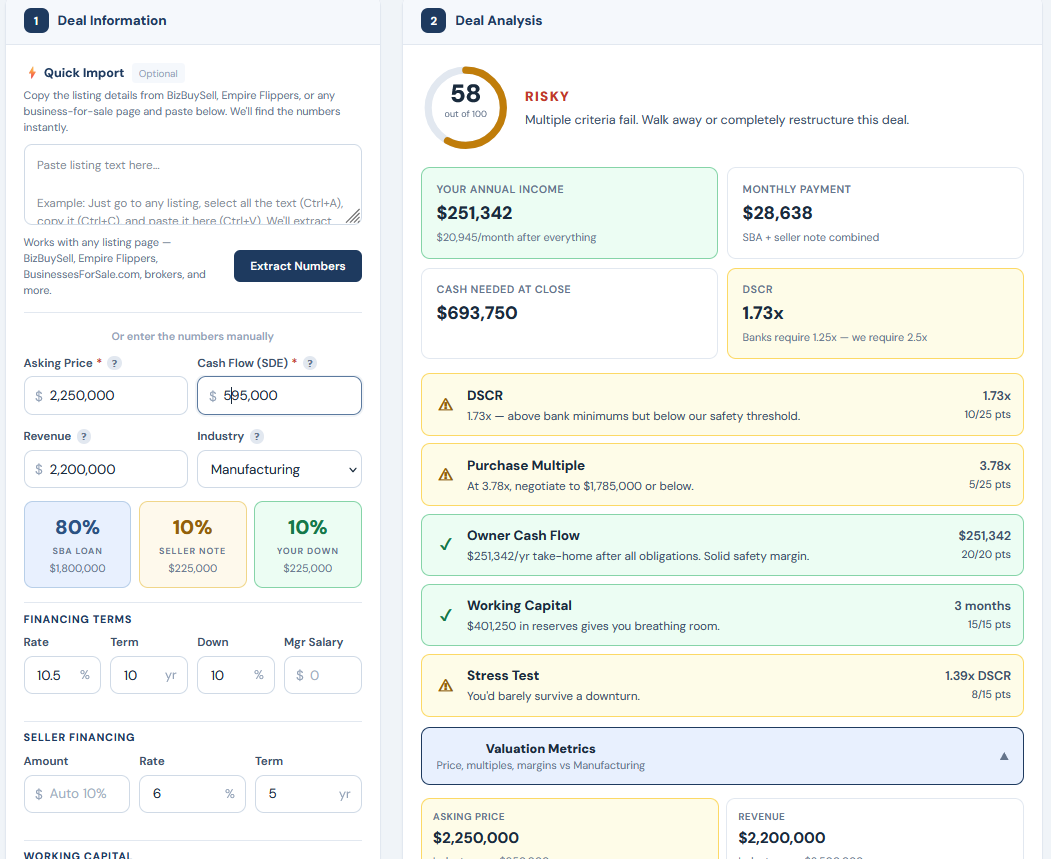
The Bulletproof Deal Calculator evaluates manufacturing acquisitions against 5 criteria that are 2x stricter than what banks require. Enter the asking price, cash flow, and revenue to get an instant Bulletproof Score with SBA financing projections and industry benchmarks.
The Bulletproof Deal Calculator with manufacturing industry benchmarks selected. Try it free →
What Makes a Bulletproof Manufacturing Deal
Manufacturing businesses can be excellent acquisitions with strong asset backing, but the capital intensity means overpaying creates dangerous leverage. Here's what we look for:
✓ DSCR 2.0x or higher (manufacturing businesses carry significant fixed costs in equipment, facility, and skilled labor that must be covered regardless of order volume)
✓ Purchase multiple at or below 3.0x SDE (manufacturing often trades above this due to equipment value, so focus on cash flow, not asset replacement cost)
✓ Owner cash flow of $100K/year or more after all debt service (manufacturing management is complex and demands real compensation)
✓ At least 3 months of working capital reserves (raw material purchases, work-in-progress inventory, and net-30/60 payment terms create large working capital needs)
✓ Survives a 20% revenue drop (if a key customer reduces orders or supply chain disruptions increase material costs, can the business still service its debt?)
Manufacturing Deals Worth Watching
We regularly scan the marketplace and score manufacturing deals against our Bulletproof criteria. Here are a few examples from real listings.
Purchase multiple of 2.1x is excellent for a certified machine shop with aerospace contracts. AS9100 certification is a significant competitive advantage. DSCR of 3.0x provides strong coverage. 5-axis CNC equipment is 4 years old. Backlog of $400K provides forward visibility.
Multiple is slightly above the 3.0x threshold but reasonable for food manufacturing with FDA compliance and established retail distribution. Proprietary recipes and co-packing relationships provide revenue stability. Negotiating to $720K would bring the multiple to 3.0x.
At 4.7x SDE with 70% of revenue from one customer, this is extremely risky. If that customer leaves, the business collapses. DSCR falls below 1.0x. Customer concentration risk alone should disqualify this deal. Price needs to drop to roughly $400K to offset the concentration risk.
Manufacturing businesses are solid SBA candidates with a 4.0% default rate below the average. The tangible asset base (equipment, inventory) provides collateral that lenders value, and the essential nature of manufacturing supports long-term viability.
Typical SBA Deal Structure
Most manufacturing acquisitions follow the 80/10/10 model. Heavy equipment may be financed through a separate SBA 504 loan (for fixed assets) alongside the 7(a) acquisition loan. If the business includes real estate, the 504 program can finance the building at favorable long-term fixed rates.
What Manufacturing Lenders Look For
SBA lenders evaluating manufacturing deals focus on the customer concentration (no single customer above 20% of revenue), the age and condition of production equipment, certifications and compliance requirements (ISO, FDA, AS9100), the order backlog and pipeline, raw material sourcing stability, and the buyer's management experience in manufacturing or a related field.
The Bulletproof Deal Calculator models SBA financing automatically, including guarantee fees, monthly payments, and cash-on-cash return. Score a manufacturing deal now →
Frequently Asked Questions
How much is a manufacturing business worth?
The typical manufacturing business sells for $300,000 to $2 million, with a median around $650,000. Valuations depend on equipment value, customer contracts, certifications, and annual SDE. CNC shops with aerospace or medical certifications command the highest prices. Use the free Bulletproof Deal Calculator to analyze any specific deal.
What are manufacturing valuation multiples?
Manufacturing businesses sell for 3.0x to 5.0x SDE, with a median around 3.5x. The premium over service businesses reflects the tangible asset base, customer relationships, and capital investment required. Companies with proprietary products, certifications, and diversified customers trade at the top of the range.
How to buy a manufacturing company?
Start by identifying the type of manufacturing that matches your experience or interests. Use the Bulletproof Deal Calculator to screen deals against financial benchmarks. Key due diligence items include equipment condition, customer contracts, certifications, environmental compliance, workforce skills, and raw material supply chain stability.
Can I buy a manufacturing business with an SBA loan?
Yes, with a 4.0% default rate manufacturing is a solid SBA category. The tangible assets provide collateral that lenders value. The 80/10/10 structure works, and the SBA 504 program can finance equipment and real estate separately. Lenders focus on customer diversification, equipment condition, and order backlog.
What is a good EBITDA multiple for manufacturing?
EBITDA multiples for manufacturing range from 4.0x to 7.0x depending on size, specialty, and customer concentration. For SBA-financed acquisitions, the SDE multiple (3.0x to 5.0x) is more relevant because it reflects what the buyer-operator earns. Larger manufacturing companies sold through M&A brokers typically use EBITDA multiples.
Manufacturing Deal Reviews
Real Manufacturing listings we scored against the Bulletproof standard — full financing math, risk flags, and an honest verdict on each.
Enter the asking price, cash flow, and revenue. Get your Bulletproof Score, SBA financing math, and manufacturing industry benchmarks. Free, no account needed.