Restaurant for Sale: Valuation Benchmarks and Deal Analysis
Thinking about buying a restaurant? This guide covers independent restaurants, franchise resales, fast casual concepts, quick-service restaurants, full-service dining establishments, and food service businesses. Use our free valuation benchmarks and restaurant valuation multiples to score any deal before you commit.
These benchmarks are drawn from acquisition data across the food service sector. The typical restaurant sells for 2.0x to 3.0x seller's discretionary earnings, with a median asking price around $350,000. Restaurant valuations vary widely by concept: fast casual operations often trade at lower multiples than full-service restaurants with liquor licenses and established brands.
Median SDE Multiple
2.3x
Range: 2.0x - 3.0x
Median Asking Price
$350K
Varies by concept
Median Cash Flow
$140K
SDE / year
SBA Default Rate
5.8%
Above avg (5.1%)
Restaurants carry a higher SBA default rate than most industries, which is why our Bulletproof criteria are especially important here. Deals that look attractive on the surface often fail the stress test when food costs spike or labor becomes scarce. The most resilient restaurant acquisitions feature a proven management team willing to stay post-sale, diverse revenue streams (dine-in, takeout, catering), and a lease with at least 8-10 years remaining.
Score Any Restaurant Deal in 60 Seconds
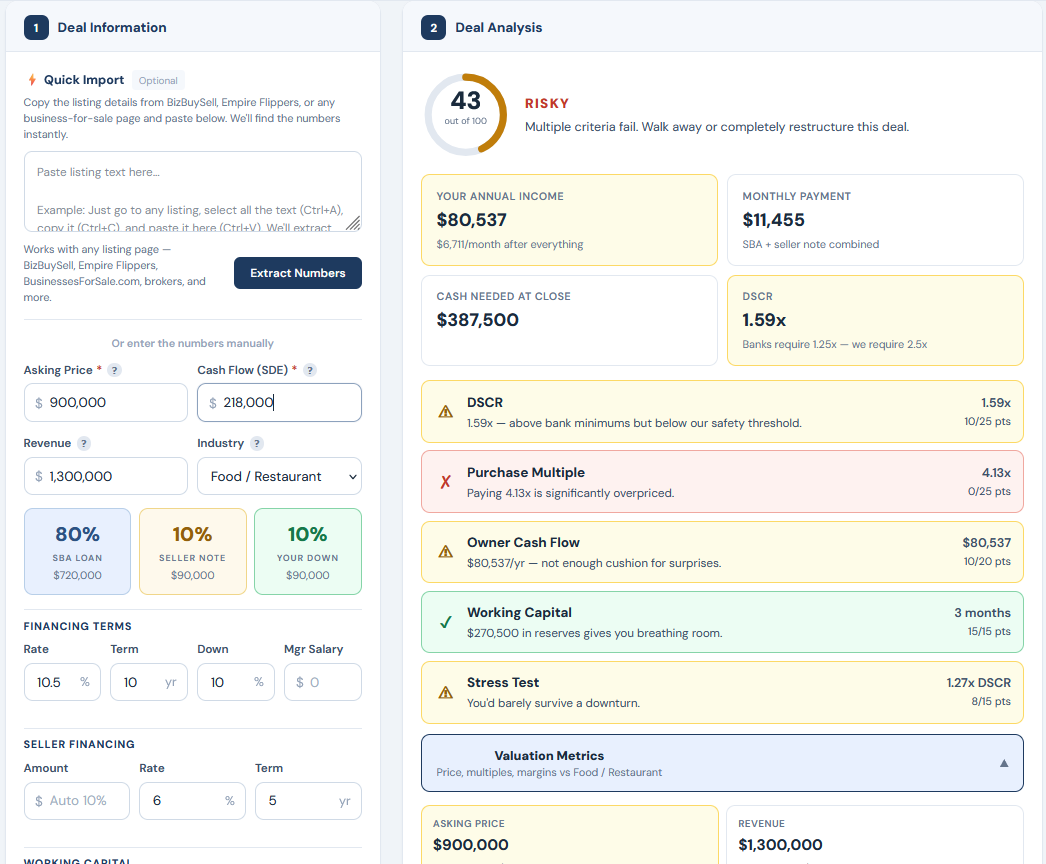
The Bulletproof Deal Calculator evaluates restaurant acquisitions against 5 criteria that are 2x stricter than what banks require. Enter the asking price, cash flow, and revenue to get an instant Bulletproof Score with SBA financing projections, stress test results, and food service industry benchmarks.
The Bulletproof Deal Calculator with restaurant industry benchmarks selected. Try it free →
What Makes a Bulletproof Restaurant Deal
Restaurants are the most commonly listed business type on every marketplace, and the failure rate reflects that. Here's what separates a deal worth pursuing from one that will drain your savings:
✓ DSCR 2.0x or higher (banks only need 1.25x, but restaurants face thin margins and volatile food/labor costs that demand extra cushion)
✓ Purchase multiple at or below 3.0x SDE (restaurants should rarely exceed 2.5x unless the brand and management team are exceptionally strong)
✓ Owner cash flow of $100K/year or more after all debt service (restaurants are labor-intensive, and the owner needs to be compensated for their time)
✓ At least 3 months of working capital reserves (food inventory is perishable, vendors require prompt payment, and slow seasons happen)
✓ Survives a 20% revenue drop (if foot traffic declines, delivery apps cut orders, or a competitor opens nearby, can the business still cover debt?)
Restaurant Deals Worth Watching
We regularly scan the major marketplaces and score restaurant deals against our Bulletproof criteria. Here are a few examples that show how the numbers play out in real food service listings.
Purchase multiple of 2.0x is excellent for a fast casual operation with strong revenue. DSCR of 2.9x provides comfortable debt coverage. Manager-run with experienced kitchen staff willing to stay. Catering revenue adds diversification.
Multiple is within range but approaching the upper end. The liquor license and 15-year track record add value. Negotiating the price down to $425K would bring the multiple to 2.5x and push this into Bulletproof territory. Key risk: head chef is the owner.
At 5.0x SDE, this deal is dangerously overpriced. DSCR would be well below 1.0x, meaning the business cannot service the debt on SBA terms. Franchise royalties of 6% further erode cash flow. The seller is pricing the brand, not the economics. Walk away or counter at $325K.
Restaurants are financeable through SBA 7(a) loans, but lenders apply more scrutiny than they do to essential-service industries like HVAC or plumbing. The higher default rate (5.8%) means underwriters want to see a clear path to profitability and a buyer with relevant experience.
Typical SBA Deal Structure for Restaurants
Most restaurant acquisitions follow the 80/10/10 model: 80% SBA 7(a) loan (up to $5M, 10-year term), 10% seller financing, and 10% buyer equity. Some lenders may require 15-20% equity for restaurant deals, especially if the buyer lacks food service management experience or if the business has had declining revenue.
What Restaurant Lenders Look For
Beyond standard DSCR requirements, SBA lenders evaluating restaurant deals look closely at the lease term and rent-to-revenue ratio (ideally under 8-10%), consistency of revenue over the past 3 years, management depth (is the operation owner-dependent or manager-run?), the condition of kitchen equipment and leasehold improvements, and the buyer's background in food service or business management.
The Bulletproof Deal Calculator models SBA financing automatically, including guarantee fees, monthly payments, and cash-on-cash return. Score a restaurant deal now →
Frequently Asked Questions
How much does it cost to buy a restaurant?
The typical restaurant sells for $150,000 to $800,000 depending on concept, location, and annual cash flow. Fast casual and QSR operations average $200,000 to $400,000, while full-service restaurants with liquor licenses and established reputations can exceed $1 million. Franchise resales add a premium for brand recognition but reduce cash flow through ongoing royalty payments. Use the free Bulletproof Deal Calculator to analyze any specific restaurant deal.
What is a good valuation multiple for a restaurant?
A good purchase multiple for a restaurant is at or below 2.5x seller's discretionary earnings. The industry median is 2.3x SDE, with a range of 2.0x to 3.0x. Full-service restaurants with liquor licenses, strong brands, and manager-run operations may justify multiples toward 3.0x. Fast casual concepts tend to trade at lower multiples because they're easier to replicate. Anything above 3.0x should raise a red flag unless the financials are exceptionally strong.
Can I buy a restaurant with an SBA loan?
Yes, restaurants are commonly financed through SBA 7(a) loans. The standard structure is 80/10/10, though some lenders may require 15-20% buyer equity for restaurant deals. SBA lenders focus on the remaining lease term, revenue consistency, management depth, and the buyer's experience. The industry's higher default rate (5.8%) means deals need stronger fundamentals to get approved. The Bulletproof Deal Calculator models the full SBA structure automatically.
What is a good profit margin for a restaurant?
A healthy restaurant operates with a net profit margin of 10-15% of gross revenue. Full-service restaurants tend toward 8-12% due to higher labor and beverage costs, while fast casual operations can achieve 12-18% with simpler staffing models. Our industry benchmark for median cash flow margin in food service is approximately 12%. If a restaurant you're evaluating falls well below that, dig into the cost structure before committing.
How much does a restaurant franchise cost?
Restaurant franchise resales range from $200,000 to $600,000 for QSR concepts and $400,000 to $1.5 million for casual dining. Franchise resales carry a premium for brand recognition and operating systems, but they also come with ongoing royalty fees (typically 4-8% of revenue) plus marketing fund contributions (1-3%). Always factor these ongoing costs into your cash flow analysis, because they directly reduce your owner earnings compared to an independent restaurant at the same revenue level.
Restaurant & Food Service Deal Reviews
Real Restaurant & Food Service listings we scored against the Bulletproof standard — full financing math, risk flags, and an honest verdict on each.
Enter the asking price, cash flow, and revenue. Get your Bulletproof Score, SBA financing math, and restaurant industry benchmarks. Free, no account needed.